AI has developed a slightly awkward reputation.
Depending on whom you ask, it’s either about to solve every business problem before lunch or destroy civilisation shortly after the afternoon stand-up. Neither view is particularly useful when you’re trying to run an actual company.
AI is a tool. An unusually capable one, certainly, but still a tool.
It can examine more information than a person could reasonably process, identify patterns, prepare recommendations, classify documents, draft responses, route work and automate repetitive decisions. Used properly, it can make organisations faster, more consistent and less dependent on people spending their afternoons copying information between systems.
That’s valuable. We’re firmly in favour of it.
What AI can’t do is accept responsibility.
It can’t explain itself to an angry customer in a way that carries any genuine accountability. It can’t appear before a regulator. It can’t own the consequences of rejecting a candidate, approving a payment or sending the wrong contractual information.
It won’t have a particularly uncomfortable meeting with the board after making an expensive mistake.
Someone else will.
That’s why responsible AI automation needs human approval by design - not as an afterthought added when something goes wrong, but as part of the workflow from the beginning.
Human approval doesn’t mean approving every mouse click
There’s a tendency to discuss human involvement as though the only options are complete autonomy or a person manually checking everything.
That would be a fairly disappointing use of automation.
AI can handle plenty of low-risk work without waiting for individual approval. It can sort incoming requests, tag records, summarise conversations, identify likely duplicates, extract information from documents and route tasks to the appropriate team.
A person doesn’t need to review every email classification individually.
But the system still needs monitoring.
Imagine employing ten people to categorise customer requests. You wouldn’t assume their work was correct forever because they completed training on their first day. You’d review outcomes, measure errors, inspect unusual cases and adjust the process when the business changed.
AI deserves the same management discipline.
Possibly more, because it can make mistakes at a scale that would require an impressively coordinated human team to reproduce.
The appropriate level of control depends on the consequences.
Misclassifying an internal newsletter is annoying. Misclassifying a customer’s cancellation request may cost money. Misclassifying a fraud alert, legal complaint or safety incident could create a much larger problem.
Good automation distinguishes between those situations instead of treating every decision as equally harmless.
The real issue is ownership
A lot of AI discussions concentrate on accuracy. Accuracy matters, but it isn’t the whole problem.
Even a highly accurate system will eventually be wrong.
People are wrong too, of course. Human involvement isn’t a magical shield against mistakes. The difference is that organisations already understand how human responsibility works. A person has a role, a manager, a defined level of authority and an escalation path.
AI often enters the organisation without any of those things.
It gets connected to a workflow, given access to data and quietly allowed to make decisions. The project is described as a success because it reduced manual work.
Then something unusual happens.
A customer receives an inappropriate response. A valid invoice is held back. A qualified candidate is screened out. An operational alert is incorrectly downgraded. Everyone starts asking why the system made that decision.
That’s usually the wrong first question.
The better questions are:
- Who owned the decision?
- Who approved the rules under which it operated?
- Who monitored its outcomes?
- Which decisions was it authorised to make?
- When was it required to escalate?
- Who could stop it?
If the answers aren’t clear, the organisation hasn’t automated responsibility. It has misplaced it.
Let AI prepare the decision without pretending it owns the decision
Many business decisions benefit enormously from AI assistance.
A financial approval process may involve transaction history, budget information, supplier records, unusual payment patterns and contractual limits. AI can collect and analyse that information much faster than a person working through several systems.
That doesn’t mean it should necessarily approve the payment.
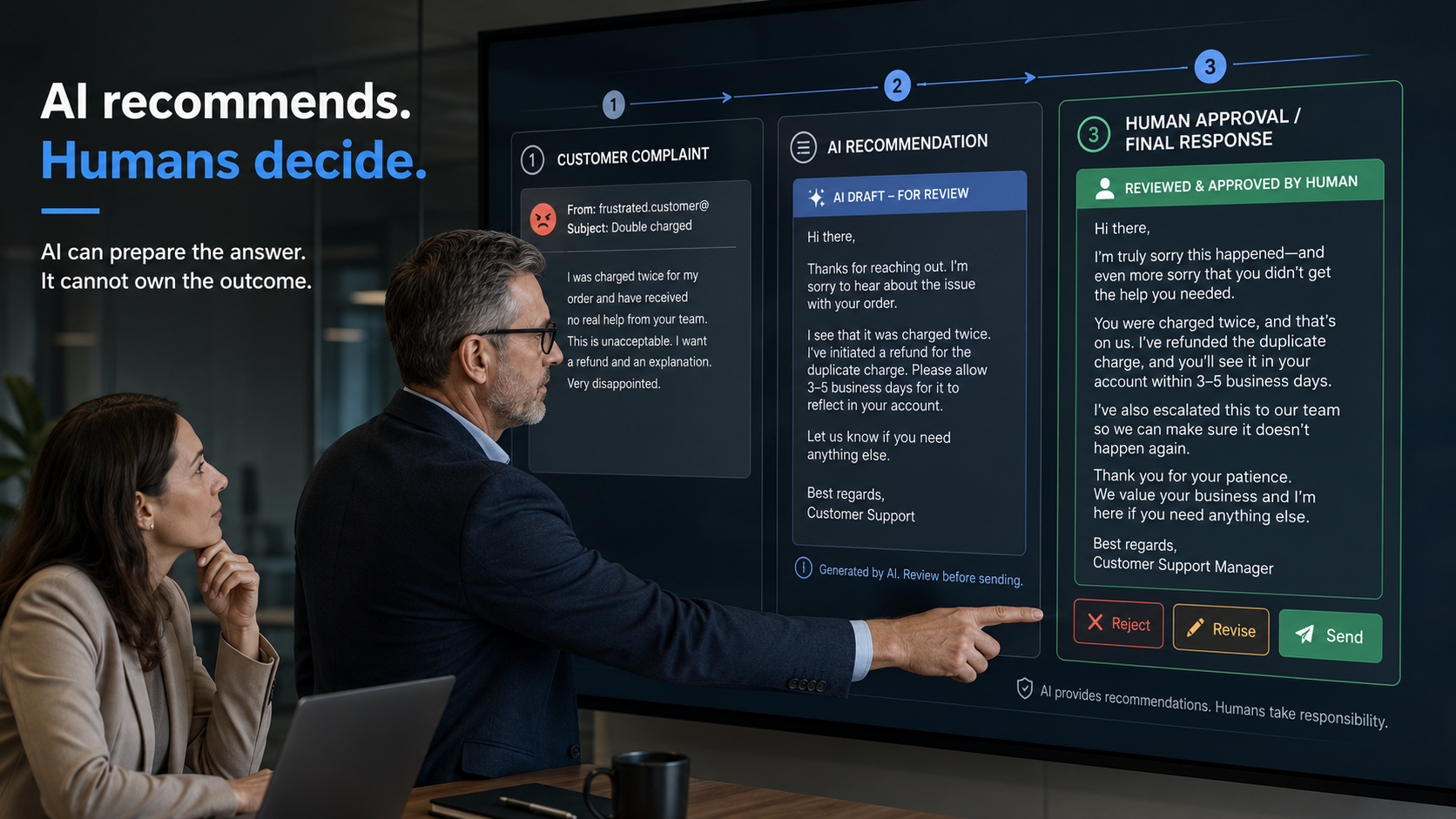
It may recommend approval, explain the supporting evidence and highlight anything unusual. A responsible human then makes the final decision when the amount, risk or exception level requires it.
The same principle applies elsewhere.
In hiring, AI can help organise applications, extract relevant experience and prepare structured comparisons. It shouldn’t quietly become the final authority on who deserves an interview or a job.
In contract handling, it can identify unusual clauses, missing terms and potential conflicts. Legal or commercial responsibility still belongs with a qualified person.
In production operations, it can correlate alerts, propose a likely cause and prepare a remediation plan. Automatically changing a live system should require controls proportional to the possible damage.
In customer service, it can summarise the customer’s history, prepare a suggested reply and recommend the next action. But when the customer is already upset, forcing them to argue with a chatbot is an efficient way to convert a service complaint into a brand complaint.
Few things say “we value your relationship” quite like repeatedly asking a machine to connect you to a human.
AI is often excellent at preparing decisions. We shouldn’t confuse that with earning the authority to make every decision.
Approval points should follow risk, not enthusiasm
The approval model doesn’t need to be complicated.
Start by looking at what the automation can affect.
Can it send information outside the company? Can it commit money? Can it alter production data? Can it reject a person, cancel an order, change a contract or make a statement on behalf of the business?
The more difficult the action is to reverse, the stronger the control should be.
A practical workflow might allow AI to:
- perform routine low-risk actions automatically;
- request approval when financial, legal or reputational thresholds are reached;
- escalate when its confidence is low;
- stop when required information is missing;
- route unusual cases to a named owner;
- record the evidence used to produce a recommendation.
That last point is particularly important.
An approval button isn’t meaningful when the person approving has no idea how the recommendation was reached. If employees are expected to take responsibility, they need enough information to make an informed decision rather than functioning as decorative humans placed beside an automated process.
And a human rubber-stamping two hundred AI decisions per hour isn’t exercising oversight either. They’re providing liability with a pulse.
Monitoring belongs in the design too
Human approval is only one part of control.
Automated systems also need operational monitoring. Teams should be able to see what the AI is doing, how often humans override it, where errors occur and whether its performance is changing.
Useful measures will vary, but they commonly include:
- the number and type of automated actions;
- approval and rejection rates;
- human override rates;
- errors detected after completion;
- escalation frequency;
- processing time;
- outcomes across different customer or user groups;
- changes following new data, policies or system integrations.
Override data is especially useful.
When people regularly reject the AI’s recommendation, that isn’t evidence that humans are getting in the way of automation. It’s evidence that the system may not understand the process as well as its designers thought.
Those disagreements are valuable. They reveal missing rules, poor data, unusual scenarios and business knowledge that never made it into the original design.
Ignoring them because they reduce the reported automation rate is how a useful tool gradually becomes an expensive source of confidence.
People need the authority to disagree with the machine
There’s another problem that receives less attention: automation bias.
People can become overly trusting of system recommendations, especially when the system appears confident or when disagreeing creates extra work.
If approving the AI’s suggestion takes one click while rejecting it requires an explanation, three forms and a meeting with someone from the transformation programme, the workflow is not neutral.
It has been designed to encourage agreement.
Human approval only works when the person reviewing the decision has:
- enough context to judge it;
- sufficient time to consider it;
- authority to reject it;
- a clear way to correct it;
- no incentive to approve it blindly.
This is partly a technical design question, but it’s also an organisational one.
Employees need to understand that AI output is a recommendation, not an instruction from an infallible digital oracle. Managers need to treat valid overrides as part of a healthy control process, not as resistance to innovation.
The calculator comparison is useful here.
If a calculator gives you a surprising answer, you check the inputs and the operation. You don’t submit the result, blame the calculator and expect everyone to consider the matter closed.
AI is far more sophisticated than a calculator, but the responsibility principle hasn’t changed.
Ethical AI is mostly operational discipline
Ethics discussions can become abstract very quickly. In practice, many ethical failures begin with quite ordinary design decisions.
A system was given access to data it didn’t need. Nobody tested whether outcomes were unfairly distributed. Customer messages were sent without review. Exceptions weren’t defined. The escalation path existed in a presentation but not in the actual software.
Responsible automation requires organisations to make deliberate choices about:
- what data the system may use;
- which decisions it may influence;
- which actions it may perform;
- what must remain under human authority;
- how affected people can challenge an outcome;
- how decisions are logged and reviewed;
- when automation must stop.
These controls aren’t obstacles to progress.
They’re what allow automation to be used confidently in processes that matter.
A company with clear boundaries can usually automate more than one relying on optimism. Teams know which actions are safe, which require approval and what happens when the system encounters something outside its mandate.
Without those boundaries, every deployment becomes a gamble between excessive caution and excessive freedom.
Neither scales particularly well.
Fewer people doesn’t mean no people
AI allows organisations to process more work with smaller teams. Pretending otherwise isn’t helpful.
The objective shouldn’t be preserving every manual task simply because a human currently performs it. Repetitive work that can be automated safely probably should be.
The mistake is assuming that reducing manual effort also removes the need for ownership, supervision and expertise.
The role of people changes.
Instead of reading every document, they review exceptions. Instead of preparing every recommendation, they validate high-impact decisions. Instead of manually moving information between systems, they monitor whether the automated process is producing the intended outcomes.
That can be better work.
It requires fewer people performing repetitive tasks and more people applying judgement where judgement actually matters.
But the remaining human role must be real. Someone must have both the responsibility and the authority to inspect, challenge and correct the system.
Calling a process “human in the loop” because an employee receives a monthly dashboard is stretching the phrase beyond usefulness.
Design responsibility before designing automation
The safest place to begin an AI automation project isn’t with the model.
It’s with the decision.
What is being decided? What information supports it? What happens when the decision is wrong? Can the action be reversed? Who is responsible for the outcome? Which cases require judgement, empathy or legal authority?
Once those answers are clear, the technical design becomes much easier.
AI can be assigned the parts it performs well: processing volume, identifying patterns, extracting information, generating options and handling predictable low-risk work.
Humans retain the parts that require accountability, contextual judgement and responsibility for consequences.
The boundary won’t be identical for every organisation or every process. A sensible approval threshold for a small internal purchase would be absurd for a major financial commitment. A customer-service draft may be safe to send automatically in one context and require careful review in another.
That’s why “add AI” isn’t a strategy.
The work lies in designing the operating model around it.
Useful technology deserves serious implementation
AI shouldn’t be treated as an employee, a decision-maker or an entity capable of owning the results it produces.
It’s a machine - and a remarkably useful one.
Used consciously, it can improve service, reduce administrative work, help teams analyse complex information and allow organisations to operate at a scale that would otherwise require far more people.
Used carelessly, it can produce bad decisions faster, distribute them more widely and leave everyone debating who was supposed to be paying attention.
Binarika helps organisations design AI-enabled workflows with practical controls built in: clear ownership, sensible approval thresholds, monitoring, auditability and escalation paths that exist outside a diagram.
That may involve creating a new controlled automation, repairing an existing process that was given too much freedom, or deciding that a particular decision shouldn’t be automated at all.
We’re pro-AI.
We’re also pro-human responsibility.
The two work very well together.