A legacy system usually doesn’t become a problem overnight.
It always starts as the thing that runs the business. Orders go through it. Customer records live in it. Operations teams rely on it. Finance exports reports from it. Support knows which screens are wrong but also knows which workarounds keep things moving.
Then, slowly, the system starts demanding the price for it.
A small change takes three weeks instead of three days. A new integration exposes old assumptions. Nobody wants to touch the billing logic because “that part is sensitive.” Releases become more tense over time. Documentation is outdated or even entirely missing. The people who understand the system are either overloaded, unavailable, or no longer with the company.
At some point, someone says the obvious thing:
“We should just rewrite it, build something new and better.”
It’s an understandable reaction. A rewrite feels clean. It promises a fresh start, a modern stack, better architecture, better UX, fewer compromises, and a way to avoid solving years of accumulated technical debt.
Sometimes that is actually the right move.
More often, though, a full rewrite is where companies tend to turn a contained legacy problem into a business continuity risk.
The hard part isn’t with writing new software. The hard part is replacing a system that’s already embedded in real operations without breaking the business it supports.
To pull that off, it requires a different approach.
Not a dramatic rebuild. Not endless patching. A controlled modernization path.
Legacy systems are rarely just software
One mistake we see often is treating the legacy system as a codebase problem.
The code may be old. The framework may be outdated. The database may be painful. The deployment process may be fragile. These may all be valid points.
But the system is usually more than the application.
It’s a map of business rules, exceptions, manual habits, operational shortcuts, reporting dependencies, undocumented approvals, and edge cases that only appear once a quarter but matter a lot when they do and the current legacy system is handling all of that.
The application doesn’t just contain logic. It contains history.
That history may be messy, but it’s also equally valuable. It explains why certain flows exist. It explains why the sales team promises one thing, why operations changes another, why finance needs a specific export, and why support has a spreadsheet that “shouldn’t exist” but somehow keeps the customer experience from falling apart.
A rewrite that ignores this usually starts with confidence and will end with surprise, and not rarely in a disaster.
The new system looks better. The architecture diagram is cleaner. The team is excited. Then real usage begins, and the business starts running into all the missing behavior nobody thought to document.
Legacy modernization has to respect the fact that the old system is doing two things at once:
- It’s creating constraints.
- It’s also carrying operational knowledge.
You need to separate those before you decide what to replace.
The rewrite instinct is often a symptom of frustration
When leaders ask for a rewrite, they’re usually not asking for a rewrite in the literal sense.
They’re asking for relief.
They want faster delivery. Fewer incidents. Less dependency on one developer. Better reporting. A cleaner customer experience. More reliable integrations. Lower maintenance risk. Less fear every time something changes.
Those are valid business goals.
But “rewrite the system” is only one possible intervention, and it’s often the most expensive one.
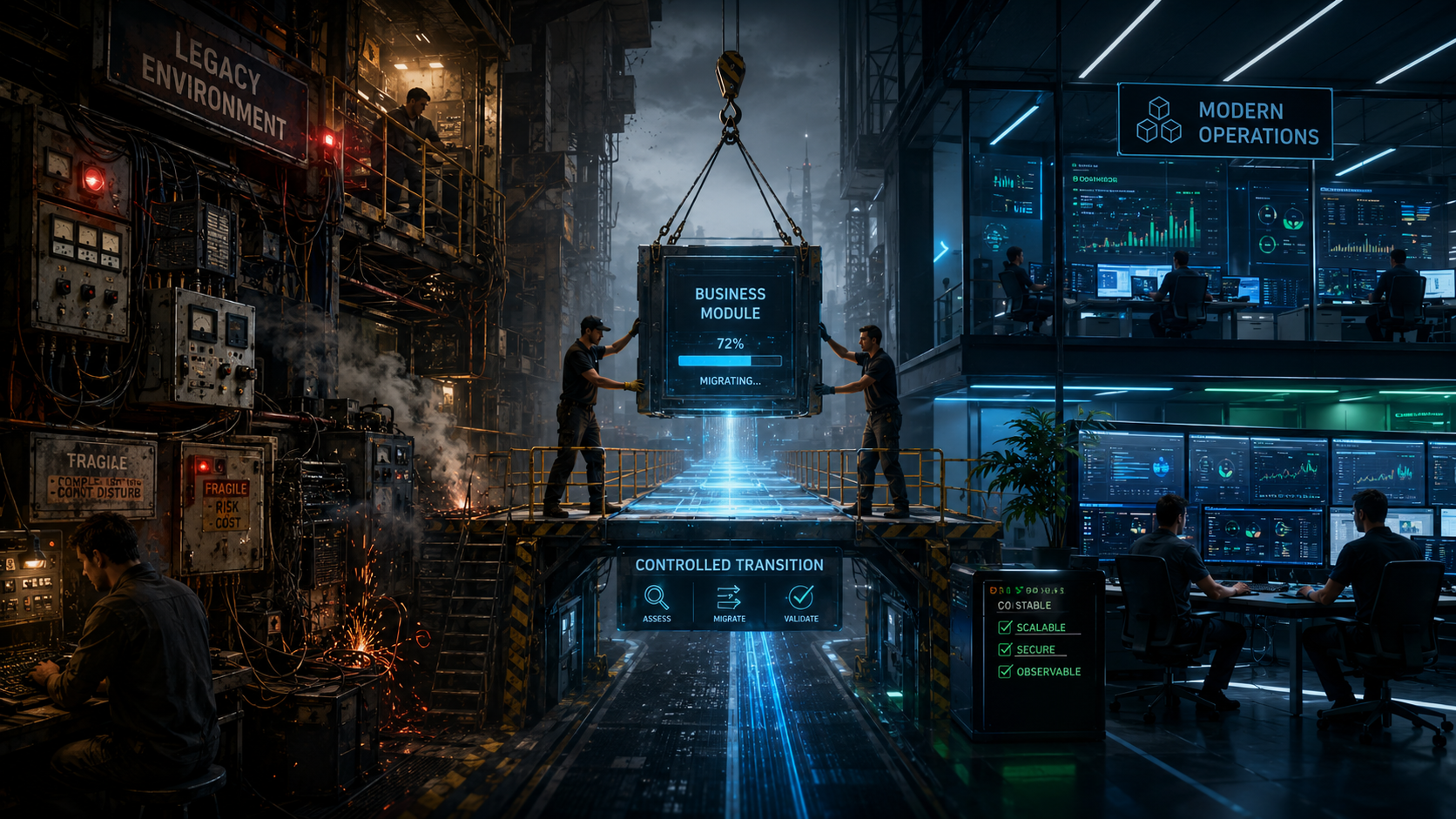
A rewrite gives the organization something emotionally appealing: a clean break from the old mess. The problem is that businesses rarely get a clean break. They get transition periods, parallel processes, data migration issues, training gaps, integration mismatches, and teams trying to run old and new workflows at the same time.
That’s unfortunately also where disruption happens.
Not because the new code is bad, but because the change path wasn’t designed seriously enough.
The question usually asked is “Should we rewrite this?”
A wiser question is “What has to change so the business becomes safer, faster, and easier to operate without creating unnecessary transition risk?”
The latter one leads to far better decisions.
Start with operational risk, not technology preference
A modernization effort should begin with the parts of the system that carry the most operational risk.
Not the oldest code.
Not the ugliest module.
Not the part developers dislike most.
The highest-risk areas are usually where software behavior and business consequences are tightly connected.
For example:
- Order processing logic that affects revenue recognition
- Billing flows where errors create customer disputes
- Inventory, scheduling, or dispatch workflows that affect service delivery
- Customer-facing flows where downtime damages trust
- Reporting exports used for financial or compliance decisions
- Integrations with third-party systems that block daily operations when they fail
This matters because legacy modernization is not a beauty contest. The goal isn’t to make every part of the system elegant. The goal is to reduce business exposure while improving delivery capacity.
That means the first phase should be purely diagnostic in nature.
Which workflows are most critical?
Which changes are requested most often?
Where do incidents happen?
Where does the team depend on tribal knowledge?
Where are manual workarounds hiding system weakness?
Where does data become inconsistent?
Where does a small mistake create a large operational cost?
Those answers tell you where modernization should start.
A team that begins with a framework upgrade before understanding operational risk may spend months improving the wrong thing. The system may become technically newer while the business remains just as exposed.
That’s just technical activity disguised as modernization, not actual modernization.
Stabilize before you replace
If the current system next to aging is also fragile, replacing it while it’s still poorly understood is risky.
This is the uncomfortable part. Many organizations want to skip stabilization because it doesn’t feel like progress. It feels like paying rent on the old world. It feels like unnecessary costs to make before doing something that is more exciting, and it is very tempting to skip this step altogether and come out with a nicer sticker price.
But stabilization is often what makes real modernization possible and skipping this step can become extremely expensive over time.
Before you carve pieces out of a legacy system, you need basic control:
- A clear release process
- Reliable backups
- Known rollback paths
- Enough logging to diagnose failures
- A way to identify critical business flows
- Test coverage around the highest-risk behavior
- Ownership for key modules and integrations
- A shared understanding of current operational dependencies
Without these, every modernization step becomes a guess and a gamble.
You don’t need perfect engineering discipline before starting. Waiting for perfection is another way to avoid the work. But you do need enough control that changes can be made without gambling with production.
In practical terms, this often means creating a safety layer around the old system first.
Add observability where failures are currently invisible. Document the business-critical paths. Protect the most sensitive flows with automated checks. Create regression tests around behavior that must not change. Improve deployment discipline. Identify which integrations are brittle and why.
Only then does replacement become a controlled move instead of a heroic one.
Modernization should happen in slices, not declarations
Large modernization programs often fail because they’re announced as a destination rather than designed as a sequence.
“We’re moving to a new platform.”
“We’re rebuilding the application.”
“We’re replacing the legacy system.”
These statements are too broad to manage well. They sound decisive, but they don’t explain how the business keeps running while the work happens.
A safer modernization path works in slices.
A slice is a meaningful piece of business capability that can be improved, isolated, replaced, or rebuilt without requiring the entire system to move at once.
Good slices usually follow operational boundaries, not technical convenience.
For example:
- Customer onboarding
- Quote approval
- Invoice generation
- Stock reservation
- Support case escalation
- Delivery scheduling
- Reporting export generation
- User permissions and access control
The point is to move one controlled area at a time.
You identify the current behavior. You define the target behavior. You decide how data will flow between old and new components. You plan rollback. You decide who owns the process after release. You measure whether the slice actually improved operations.
This is the preferred way to make modernization manageable.
Not because it’s small, but because each step has a clear business boundary.
The strangler pattern works, but only with business discipline
In technical circles, people often talk about the strangler pattern: gradually replacing parts of an old system by routing specific functionality to new services or modules until the old system becomes smaller and less central.
It’s a good pattern.
But It’s also often oversimplified.
The technical idea is only half of it. The business discipline matters just as much.
For the pattern to work, each extracted capability needs clear ownership, clear data rules, and clear release criteria. Otherwise the company ends up with two systems, duplicate logic, inconsistent data, and nobody quite sure which version is authoritative.
Unfortunately this is where many modernization efforts drift.
The team builds a new module, but the old workflow still exists. Some users move to the new flow, others stay on the old one. Reports pull from both places. Support doesn’t know which screen reflects the truth. Operations starts using spreadsheets during the transition. Eventually, the business has more complexity than before and in some cases reverted to pre-automation era.
At this point we do not have a modernization problem in the narrow technical sense. We turned it into a governance problem.
Every modernization slice needs answers to plain questions:
Who owns this business capability?
Which system is the source of truth?
What happens to old data?
What happens when old and new behavior disagree?
Who signs off that the new flow is operationally ready?
How do we roll back if the release causes disruption?
When is the old path formally retired?
Without clear answers, “gradual modernization” will become permanent duplication.
Data migration is not a side task
We have a saying: Data migration is where optimism goes to die.
Most teams underestimate this because they think of migration as just moving records from one database to another, and maybe transforming some of it. In reality, data migration is a business interpretation exercise.
Legacy data usually contains old rules, incomplete fields, duplicate entities, historical exceptions, inconsistent statuses, abandoned workflows, and records that made sense at the time but no longer fit the current model.
You can’t safely migrate that by writing a script and hoping for the best.
You need rules:
Which records move?
Which records are archived?
Which statuses are still valid?
Which fields become required?
How are duplicates handled?
Which data gets cleaned before migration, and which gets corrected during normal operations?
Who has authority to decide ambiguous cases?
The last question also matters more than teams admit.
Developers can write migration tools. They shouldn’t be forced to guess business meaning.
If the old system has three versions of “completed,” someone from the business needs to define what those mean in the new world. If customer records contain duplicate billing entities, finance or operations needs to help decide how they consolidate. If historical records are legally or commercially sensitive, they need appropriate handling.
A clean migration is rarely purely technical. It’s a shared accountability exercise.
Keep the business running with parallel control, not chaos
There are moments when old and new systems need to run in parallel.
That’s normal. It can be safe.
But parallel operation needs to be designed deliberately.
The danger is not that two systems exist at the same time. The danger is that people don’t know what each system is responsible for.
During transition, teams need very clear rules:
- Which users work in which system
- Which data is authoritative
- Which actions are still performed in the legacy system
- Which actions have moved to the new workflow
- How exceptions are handled
- How support escalates problems
- How reports are validated
- When the old path will be disabled
This is less glamorous than new architecture, but it’s the part that protects the business.
A modernization effort that ignores daily operations will force the company into informal coordination. That means Slack messages, side spreadsheets, manual checks, and “ask Anna, she knows how this works.”
That may get the team through a week, but it won’t support a serious transition.
The business needs a controlled operating model while modernization is in progress.
Don’t modernize everything equally
Not every part of a legacy system deserves the same investment.
Some parts should be replaced. Some should be wrapped with better interfaces. Some should be stabilized and left alone for now. Some should be retired because the business process itself is obsolete.
Leadership discipline is what really matters here.
A modernization effort can easily become a dumping ground for every frustration the organization has carried for years. Everyone sees a chance to fix their old pain. The scope then keeps growing. The timeline keeps stretching. The business case just gets weaker.
You need a decision model for this situation.
For each area of the system, ask:
Is this capability still strategically important?
Does it change often?
Does it create operational risk?
Does it block delivery?
Does it depend on fragile knowledge?
Does replacing it reduce cost, incidents, or delivery friction?
Does keeping it create unacceptable future risk?
These questions will help separate valuable modernization from expensive tidying.
A module that’s ugly but stable, rarely changed, and low-risk may not deserve immediate replacement, regardless of how the people that work with it feel about it.
A module that looks simple but controls revenue, customer commitments, or operational scheduling may deserve attention first.
Modernization should be guided by business impact, not irritation or how vocal users are about it.
The team structure has to change too
Legacy problems are often reinforced by team structure.
One person owns too much. Product decisions arrive without technical review. Operations creates workarounds because software changes take too long. Developers avoid certain modules because nobody trusts the release process. QA is involved too late. Support learns about changes after customers do.
A modernization effort that only changes code won’t fix that.
The organization needs clearer ownership boundaries.
Someone has to own the legacy system during transition. Someone has to own the new capability being introduced. Someone has to own data decisions. Someone has to own release readiness. Someone has to represent business operations honestly, not just sign off after the fact.
This doesn’t require a large committee. In fact, too many committees slow everything down.
It just requires named accountability.
A modernization program with unclear ownership will drift into meetings, opinions, and delayed decisions. A program with clear ownership can make controlled trade-offs.
That’s usually the difference between progress and motion.
Signs that your rewrite plan is already in trouble
A legacy rewrite or modernization effort is likely to create disruption if these signs are present:
The team can’t explain the current business-critical workflows clearly.
The rewrite scope is described mostly in technical terms.
There’s no agreed source of truth for key data.
The business assumes the new system will “just work like the old one, but better.”
The old system has no reliable test coverage around critical behavior.
There’s no rollback plan for each release.
Operations and support are not involved until late in the process.
Data migration is treated as a final-stage task.
The project plan has a big-bang launch date and few controlled interim releases.
Nobody has defined when old workflows will be retired.
These aren’t small warning signs. They mean that the organization is underestimating transition risk.
The cost won’t only show up in development. It’ll show up in delayed launches, manual cleanup, customer issues, reporting errors, staff frustration, and emergency fixes after release.
What a safe modernization path looks like
A risk-managed modernization effort usually follows a sequence like this:
First, understand the operating reality. Map the critical workflows, data dependencies, integrations, user groups, reporting needs, and manual workarounds. Don’t rely only on code analysis. Talk to the people who use the system under pressure.
Second, identify the highest-risk areas. Look for flows where failures affect revenue, customers, compliance, delivery, or decision-making. These areas need control before they need beauty.
Third, stabilize the existing system enough to change it safely. Improve release discipline, observability, backups, rollback paths, and regression coverage around critical behavior.
Fourth, choose modernization slices based on business boundaries. Avoid vague platform-level goals. Pick capabilities that can be moved, improved, or isolated with clear operational ownership.
Fifth, define data authority and transition rules before building too much. Decide which system owns which data, how synchronization works, how exceptions are handled, and when old paths are retired.
Sixth, release in controlled steps. Each release should have a business owner, acceptance criteria, operational handoff, rollback plan, and monitoring.
Seventh, measure whether the modernization is actually helping. Faster change cycles, fewer incidents, reduced manual work, clearer ownership, better reporting, and lower dependency on fragile knowledge are better indicators than “percentage of system rewritten.”
This sequence may sound less exciting than a full rebuild, but that is exactly the point:
The goal is not to create drama. The goal is to improve the system while the business keeps operating and keeps generating revenue.
Where Binarika helps
Legacy modernization needs more than development capacity.
It needs technical judgment, operational discipline, and a realistic transition plan.
At Binarika, we help companies assess legacy systems from both sides: the software structure and the business workflows around it. We look at where delivery is slowing down, where operational risk is hiding, where ownership is unclear, and where a rewrite would create more disruption than value.
Sometimes the right answer is to stabilize and modernize in place.
Sometimes it’s to extract one critical capability into a cleaner architecture.
Sometimes it’s to replace a legacy module gradually while keeping the rest of the system running.
And yes, sometimes a rewrite is justified.
But it should be a well-considered decision, not a reflex.
The companies that handle legacy modernization well don’t pretend the old system has no value. They also don’t keep making excuses for it forever. They separate what must be preserved from what must be changed, then move in a sequence the business can absorb.
That’s the practical path.
Modernization without business disruption isn’t about avoiding change.
It’s about changing the right things in the right order, with enough control that the business doesn’t have to pay for technical progress through operational chaos.