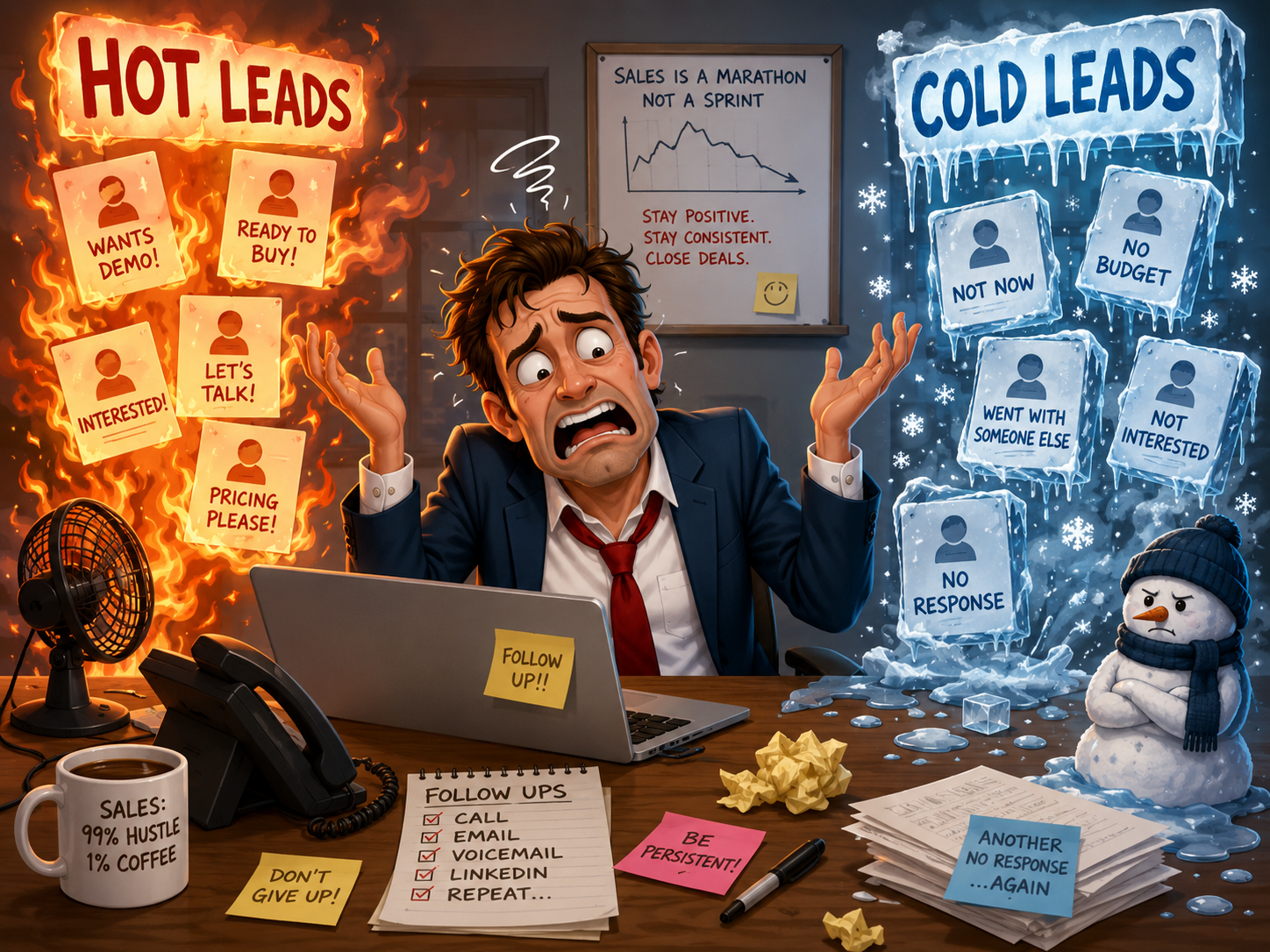
Most companies that depend on inbound leads have the same hidden problem: They pay to generate interest, handle the active opportunities, send quotes, make calls, and then lose a large part of the pipeline when prospects stop responding.
Some of those leads are genuinely lost. Some were never a good fit. Some may have chosen a competitor instead. Some were too price-sensitive or outside the budget of the prospect. Some were mere curiosity and never true intent. And then there is some that were simply not ready.
But not all cold leads are dead.
In quote-based service businesses, especially in areas such as relocation, moving, logistics, even cleaning services, timing matters. A prospect may request a quote weeks or months before the actual need becomes urgent. They may speak to several providers, compare prices, pause the decision, become busy, or wait until the deadline becomes real.
The commercial problem is simple: by the time that the moment arrives, most sales teams no longer have a structured way to know which dormant leads are worth reopening.
This is exactly where AI can help - but only if it is used carefully.
Cold lead recovery is not just “send another follow-up”
Most cold lead recovery fails because it is treated as a messaging problem.
The usual assumption is that the company needs a better follow-up email. So the sales team writes a few templates, maybe adds some automation, and sends another sequence to everyone who did not reply.
That is not recovery. That is noise.
The harder question to ask is not "what email should we send?" The harder question is: Which cold leads are still commercially realistic, and why?
A serious recovery process needs to distinguish between different situations:
- a lead whose moving date for example has already passed.
- a lead that clearly rejected the price.
- a lead with too little data to approach intelligently.
- a lead that looked serious, but went quiet.
- a lead with an upcoming deadline.
- a lead that received a quote but never made a final decision.
- a lead where the previous follow-up was too early, too late, or simply too generic.
These situations should not receive the same treatment.
This is where many sales processes break down. The CRM contains data, usually all data necessary to make these assessments, but the data is not being converted into useful sales judgments by the sales team for various reasons.
The real issue: CRM data exists, but it is not operationalized
In many companies, CRM history is treated as storage. It records what happened, but it does not actively help the sales team decide what to do next.
Useful information may already exist:
- original lead form data
- origin and destination, or location of the required service
- intended service date
- quoted budget or offer details
- communication history
- sales notes
- previous offers
- status changes
- time since last contact
- actions from sales persons and communication attempts
The problem is that this information is often fragmented, inconsistent, incomplete, or too time-consuming for a salesperson to review manually across hundreds or thousands of dormant leads.
So the practical outcome is predictable.
Follow-up depends on individual discipline. Some salespeople are persistent. Others move on. Some leads are contacted too early. Others are contacted too late. Many receive the same generic follow-up regardless of context.
The company may think it has a lead quality problem. In reality, it often has a sales intelligence problem.
What makes a cold lead recoverable?
For the AI-assisted cold lead recovery system we developed, the first important decision was not how to generate emails. It was how to avoid contacting the wrong leads.
A cold lead was only useful for recovery analysis if there was still a realistic commercial reason to reopen the conversation. For example:
- the intended service date has not yet passed
- the timeline was close enough to create urgency
- the lead had previously received a quote.
- the prospect had shown meaningful intent.
- there was enough communication history to understand the context.
- the lead was not clearly marked as lost.
- there was no compliance or legal reason preventing recontact.
- the previous interaction did not indicate that renewed contact would be inappropriate.
This matters because cold lead recovery is not about chasing everyone.
A good system should be able to say: do not contact this lead.
That may sound counterintuitive, but it is one of the most important parts of the process. Some leads are too old. Some have too little data. Some have already passed the relevant deadline. Some clearly rejected the price. Some are duplicates or low-quality inquiries. Some are commercially unrealistic. Some carry a high risk of annoying the prospect and damaging trust.
The goal is not more activity. The goal is better activity.
What AI can usefully recommend
Once the recoverable segment is identified, AI becomes useful as a structured sales assistant.
At a high level, the system can support recommendations such as:
- lead recovery priority
- suggested timing for recontact
- likely angle for reopening the conversation
- phone script
- email draft
- objection-handling suggestions
- risk flags
- confidence level
- "do not contact yet"
- "probably not worth pursuing"
The important point is that these recommendations are based on context. A lead that went silent after receiving a quote should not be handled the same way as a lead that never responded after the first call. A prospect with an upcoming deadline should not be handled the same way as someone whose timeline has already passed.
AI is useful because it can review a larger amount of messy sales history than a human can reasonably process one lead at a time. But the output still has to be constrained, reviewed, and approved.
AI should not be in the driver’s seat
This is where many AI sales implementations become reckless.
An AI system should not be allowed to send customer-facing messages automatically in this kind of workflow. It should not change lead statuses by itself. It should not make price promises. It should not override compliance rules. It should not decide that a customer should be contacted if business rules say otherwise.
For this system, the controls were explicit:
- a salesperson edits and approves every message before sending.
- AI cannot send emails directly.
- AI cannot make changes to lead status.
- AI cannot make pricing promises.
- AI cannot override compliance or privacy rules.
- sales managers can review recommendations.
- recommendations are logged and auditable.
This is not philosophical detail. It is the difference between useful sales support and careless automation.
AI is a tool. It is not the goal.
Privacy is not optional
Cold lead recovery requires sensitive context. Lead histories can include names, contact details, origin and destination information, intended service dates, notes from conversations, offer details, and salesperson observations.
That information should not be casually copied into public AI tools.
For sales intelligence work, the safer architecture is controlled infrastructure, private model deployment, access control, auditability, and human approval before any customer-facing action. This is especially important for companies operating under GDPR or handling European customer data.
The point is not that AI cannot be used. The point is that AI has to be implemented with the same seriousness as any other system that processes personal or commercially sensitive data.
For this reason, we did not treat model selection as a simple “which model writes the nicest email?” exercise. The system needed to work inside a controlled environment and respect operational constraints.
The early recovery numbers
The early data showed why this kind of workflow is commercially interesting, even when recovery rates are modest.
From the eligible dormant lead pool, around one-fifth of leads were considered worth recontacting. That alone is important: most cold leads were not treated as worth pursuing.
From the selected recovery group, early runs showed single-digit response and reactivation rates, with low single-digit conversion into actual sales.
That may sound small until you consider the economics.
In quote-based service businesses where each job may be worth hundreds to several thousand euros, even a small number of recovered deals can matter. These are not new paid leads. They are opportunities the business already paid to acquire, already quoted, and would otherwise likely handle inconsistently or ignore.
The business case is not that AI magically converts cold leads. It does not.
The business case is that AI can help recover a commercially meaningful minority of opportunities from a lead pool that was already sitting inside the CRM.
The hard part was not generating text
A weak version of this system would simply generate follow-up emails.
That was not the hard part.
The hard part was making the recommendations reliable enough to be useful.
Several issues appeared quickly:
- CRM data was inconsistent
- sales notes were incomplete
- lead statuses did not always tell the full story
- models drifted away from the actual context
- models ignored or misinterpreted hard data
- models misread signals
- models struggled to follow strict business logic.
- models sometimes hallucinated information that was not present
- outputs had to be constrained so they remained useful and safe
This is the part many AI sales discussions skip.
Large models can produce convincing text even when the reasoning is weak. That is dangerous in sales, because a confident but wrong recommendation can damage trust, waste time, or create compliance risk.
A useful AI sales system needs more than language generation. It needs boundaries, evaluation, data discipline, business rules, and review mechanisms.
What this revealed about the sales process
The project also exposed a broader operational issue.
Many companies do not have a real cold lead recovery process. They have a CRM, salespeople, notes, quotes, and follow-up habits. That is not the same thing.
A proper recovery process requires answers to questions such as:
- When does a lead become cold?
- When is it still worth recontacting?
- What makes a lead commercially recoverable?
- What makes a lead too risky or too low-value to pursue?
- What timing signals matter?
- What previous interactions should change the recontact angle?
- What should salespeople never promise?
- How should managers review recovery quality?
- How should outcomes feed back into future decision-making?
AI can support these decisions, but it cannot compensate for a company refusing to define them.
In fact, one of the most useful effects of building an AI-assisted recovery system is that it forces the business to clarify its own sales logic.
AI for sales process improvement should be controlled, not theatrical
There is too much AI work being sold as spectacle.
More automation. More generated messages. More dashboards. More claims about replacing human work.
That is not what sales-heavy SMEs usually need.
They need practical systems that improve a real process:
- recover ignored opportunities
- prioritize sales effort
- reduce wasted manual review
- improve follow-up timing
- make better use of CRM history
- protect customer data
- keep humans accountable
The strongest use of AI in this context is not replacing the salesperson. It is helping the salesperson make a better decision with better context, faster.
The lesson for sales-heavy service companies
If your company receives many inbound leads, sends quotes, and loses a large percentage of prospects to silence, the first question is not whether you need more leads.
You may first need to understand what is happening to the leads you already paid for.
Cold lead recovery is not about chasing everyone. It is about identifying the minority of dormant opportunities where timing, context, and previous intent still create a realistic chance of reopening the conversation.
AI can help with that. But only if it is implemented with restraint.
The system must be private enough to protect sensitive lead histories. It must be constrained enough to follow business rules. It must be auditable enough for managers to trust. And it must keep humans in control of every customer-facing action.
At Binarika, we build practical AI systems around real business processes. For sales-heavy SMEs, that means helping teams recover revenue from ignored leads without reckless automation, without exposing customer data unnecessarily, and without pretending that AI should replace human judgment.
If your CRM contains months of dormant leads and your team has no structured way to decide which ones are still worth pursuing, there may be recoverable revenue already sitting in your pipeline.
The question is whether your process is capable of finding it.