There’s an attractive idea hiding inside most CRMs.
Thousands of leads are sitting there. Some received a quote. Some had several conversations with sales. Some appeared ready to buy and then disappeared. The company already paid to acquire them. Salespeople already spent time on them. Surely there’s revenue left in that database.
So let's add AI, and the opportunity seems even more compelling. It can read old notes, reconstruct conversations, rank prospects and prepare personalised follow-ups without asking a salesperson to spend three days excavating the CRM like an archeologist.
That part is true.
The problem begins when a business misinterprets the ability to contact dormant leads as a reason to contact them. AI makes outreach easier. It does not automatically make the outreach appropriate, commercially sensible or welcome.
Without clear guardrails, lead recovery can quickly become an efficient way to remind former prospects why they stopped replying in the first place.
Dormant doesn’t mean available
“Cold lead” is a convenient CRM label. But it’s not a meaningful description of the relationship.
One prospect may have postponed the project because their budget was frozen. Another may have selected a competitor. Someone else may have asked not to be contacted again. A fourth may still be interested, but nobody followed up when the timing was right.
They can, and on the surface all look identical in a sales report.
That’s why treating dormant leads as one audience is dangerous. The database shows that communication stopped. It often doesn’t explain whether communication should restart.
In our earlier article, AI Cold Lead Recovery: Recovering Dormant Sales Opportunities Without Reckless Automation, we explored how AI can help businesses find the smaller group of neglected opportunities that may genuinely be worth revisiting.
The word 'smaller' is significant here.
A sensible recovery process isn’t designed to squeeze another email out of every historical record. Its value comes from distinguishing plausible opportunities from people who should be left alone.
The most useful decision may very well be: don’t contact this person.
That doesn’t look exciting on an automation dashboard, but it prevents a great deal of unnecessary damage.
AI scales whatever judgment already exists
Companies often talk about using AI to scale sales activity.
That’s unfortunately slightly backwards.
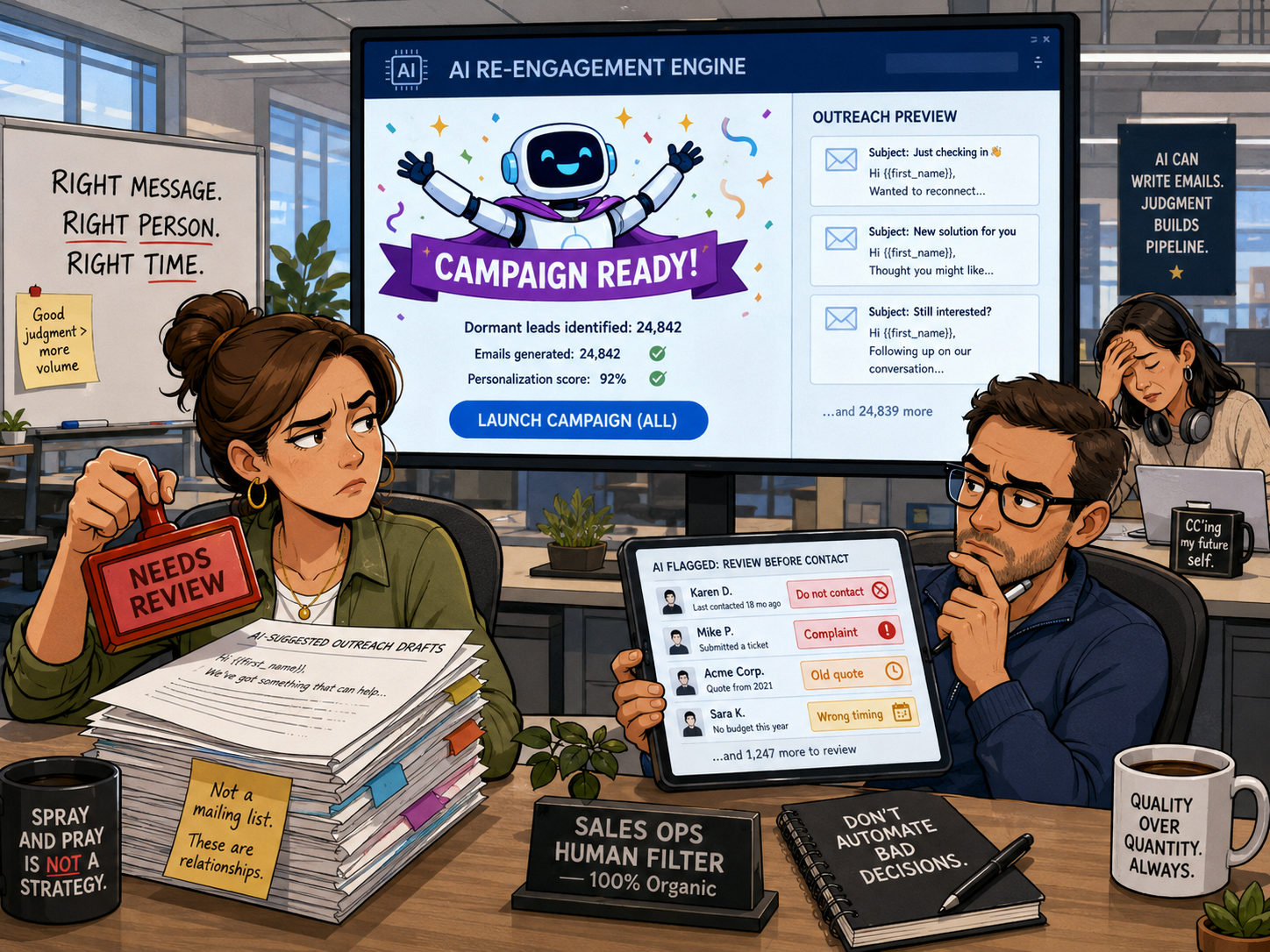
AI scales the decisions behind the activity. If those decisions are thoughtful, the system can save time and help the team focus. If they’re vague, inconsistent or commercially aggressive, AI simply applies the weakness to more people, more quickly.
Manual work contains friction. A salesperson reviewing old leads one by one will notice things that don’t fit neatly into a data field. They may remember that a conversation ended badly. They may see that the original request is no longer relevant. They may decide that another follow-up would be more embarrassing than useful.
Automation removes much of that friction.
Usually, that’s the whole point of automation. But friction also sometimes acts as an accidental safety mechanism. Removing it before the business has defined its boundaries can turn an untidy sales process into a highly organised nuisance for the prospects.
This is why the hard part of AI lead recovery isn’t generating a message.
The hard part is deciding when the business has earned the right to send one.
Guardrails aren’t just legal restrictions
The word “guardrails” often gets reduced to compliance.
Compliance matters, obviously. A business needs to respect consent, opt-outs, data handling obligations and the rules that apply to its market.
But a campaign can remain technically compliant and still be commercially foolish.
A prospect may not have formally opted out, yet contacting them again may be inappropriate because the relationship ended badly. Another may be legally contactable but clearly irrelevant because the project date has passed. Someone may still exist in the CRM even though another salesperson is actively handling the account.
These aren’t edge cases. They’re normal consequences of running a business through systems maintained by busy people.
Good guardrails therefore reflect more than regulation. They encode the company’s commercial judgment, customer standards and appetite for reputational risk.
That judgment cannot be downloaded as a generic template.
The boundary between a forgotten opportunity and an unwanted contact is different for every organisation. It depends on the service, sales cycle, customer history, CRM quality, internal ownership and promises already made.
Those boundaries need to be resolved before AI is given permission to act.
A polished explanation can still support a bad decision
One of the more subtle risks of AI-assisted sales is that weak recommendations can sound remarkably convincing.
A model may explain that a prospect has “strong recovery potential” because they requested a quote, opened several emails and had multiple conversations with the company. That all sounds very reasonable.
It may also ignore the note at the end of the record saying that the customer was dissatisfied, chose another supplier or requested no further contact.
People are naturally influenced by coherent explanations. When the wording is polished, it becomes easier to confuse confidence with accuracy.
This is especially risky when the CRM is incomplete.
AI can help interpret history, but it cannot recover facts that were never recorded. It cannot reliably know whether silence meant lost interest, bad timing, internal politics, a personal conversation that happened off-system or simple neglect by the sales team.
A responsible system should expose uncertainty rather than burying it beneath a persuasive paragraph.
If the data doesn’t support a reliable recommendation, the output shouldn’t be more confident language. It should be a reason for caution.
“Human approval” can become theatre
Many companies feel safe as soon as they add a human approval step.
The AI prepares the outreach. A salesperson checks it. Nothing gets sent automatically.
On paper, the human is in control.
In practice, that control can be almost meaningless.
Give someone a queue of 200 polished messages, measure how quickly they clear it and place a large green approval button in front of them. Most of the messages will be approved with only a glance.
The person hasn’t been given a genuine decision. They’ve been assigned the role of confirming that the machine probably knows what it’s doing.
Meaningful review requires context.
The salesperson needs to understand why the lead was selected, which facts were considered, where the system is uncertain and what could make the outreach inappropriate. They also need the freedom to reject the recommendation without turning that rejection into an administrative project.
Human oversight is only valuable when it adds judgment and the ability to pass judgement.
When it exists only to transfer blame from the system to an employee, it’s decorative.
Personalisation has a point where it stops feeling personal
AI is very good at producing messages that refer to past conversations.
That’s often presented as an obvious benefit. A follow-up mentioning the original project or unresolved question is more relevant than a generic “just checking in.”
But relevance and comfort aren’t the same thing.
A business may possess years of notes, messages, personal circumstances and inferred preferences about a prospect. That does not mean all of that information should appear in a new email.
There is a point where personalisation begins to feel less like good service and more like surveillance.
The test is not simply whether the information exists in the CRM. The better question is whether using it helps the recipient understand why the company is getting back in touch.
If the detail exists mainly to prove how much the system knows, it probably doesn’t belong in the message.
This is also where generated content creates risk. A model can smoothly turn assumptions into apparent facts. It may imply that a salesperson remembers a conversation they’ve never seen, suggest urgency that doesn’t exist or present an old estimate as though it were still valid.
The language can be flawless while the message itself is misleading.
That’s not a copywriting problem. It’s a control problem.
Silence needs to remain an acceptable outcome
A poorly designed recovery process has an answer for every lack of response: send another message.
Perhaps the second email should be shorter. The third can use a different angle. The fourth can sound more personal. Eventually, the prospect receives a note asking whether the previous messages got lost.
They didn’t.
A mature sales operation knows that recovery doesn’t mean indefinite pursuit.
Sometimes the prospect has moved on. Sometimes the timing is wrong. Sometimes the opportunity was never as strong as the CRM suggested. Sometimes there is no hidden objection waiting for the right AI-generated sentence.
The system needs to understand that no reply is also information.
This isn’t an argument against follow-up. Good opportunities are lost because businesses stop too early or fail to follow up at all.
But there’s a difference between disciplined persistence and automated refusal to take the hint.
The business must decide where that boundary sits. AI shouldn’t invent it during the campaign.
Weak CRM discipline becomes an AI problem very quickly
Lead recovery projects also have a habit of exposing uncomfortable truths.
The company may discover that nobody agrees on when an opportunity is truly lost. Sales statuses may mean different things to different people. Important decisions may be buried in email inboxes. Opt-outs may be stored in free-text notes. Ownership may be unclear. Records may remain open long after the underlying need has disappeared.
None of this is unusual.
It does, however, matter.
AI can analyse inconsistent processes, but it cannot turn them into a coherent operating model by itself. At best, it produces recommendations based on conflicting evidence. At worst, it gives the conflicts a professional-looking explanation and sends them to the customer.
This is why AI lead recovery is rarely just an AI project.
It touches sales policy, data quality, ownership, customer experience, system integration and management judgment. The technology may be the visible part, but most of the risk sits around it.
Businesses that skip this reality often end up blaming the model for decisions the organisation never made.
Activity is a poor substitute for value
Lead recovery systems can produce very impressive numbers.
Thousands of records analysed. Hundreds of messages prepared. Response rates increased. Salespeople saved hours of manual work.
Those numbers may be useful, but they can also hide what matters.
A campaign that generates replies while increasing complaints is not necessarily successful. Neither is one that reopens many opportunities but fills the pipeline with people who are unlikely to buy. Even recovered revenue can be misleading if the outreach damages valuable relationships elsewhere.
The commercial question is not how much activity the system produced.
It’s whether it helped the business identify and recover worthwhile opportunities without creating a larger cost in trust, employee time or operational risk.
That’s a more demanding measure.
It is also far closer to the reason the project existed in the first place.
The system should strengthen sales judgment
AI lead recovery works best when it helps a sales team see what it would otherwise miss.
It can surface an opportunity that went quiet because ownership changed. It can summarise a long conversation that nobody has time to reconstruct. It can highlight that the customer’s original timing may now be relevant. It can prepare useful context before a salesperson decides what to do.
Those are valuable capabilities.
But there is an important difference between helping someone make a better decision and quietly making the decision on their behalf.
The first strengthens the sales operation.
The second replaces unresolved business judgment with automated confidence.
A well-designed system should make the team more selective, not merely more active. It should help people recognise when another conversation is justified and when restraint is the better commercial choice.
That requires guardrails, but not as an afterthought.
They are part of the product.
The real question comes before the first message
The obvious question in lead recovery is:
“What should we send?”
It’s usually too early for that.
Before discussing tone, personalisation or channels, the business needs to answer something more fundamental:
Why should this person hear from us again?
If that answer is unclear, AI will not make it clearer by producing a polished email.
It will simply make the uncertainty harder to see.
At Binarika, we approach AI-supported workflows as operational systems, not isolated model demonstrations. The value isn’t in connecting a CRM to a language model and watching it generate text. It’s in defining where automation helps, where judgment is required and where the system must refuse to proceed.
Dormant leads may contain real commercial opportunities.
They also contain old decisions, incomplete records, damaged relationships and people who have already moved on.
The difference between recovering value and damaging trust is rarely the quality of the generated message.
It’s the quality of the decisions made before that message exists.